
Feelings Can Override Reason: Finding Balance in Decision-Making
By David Hennessy, Clinical Psychologist, Varsity Lakes, Gold Coast, QLD
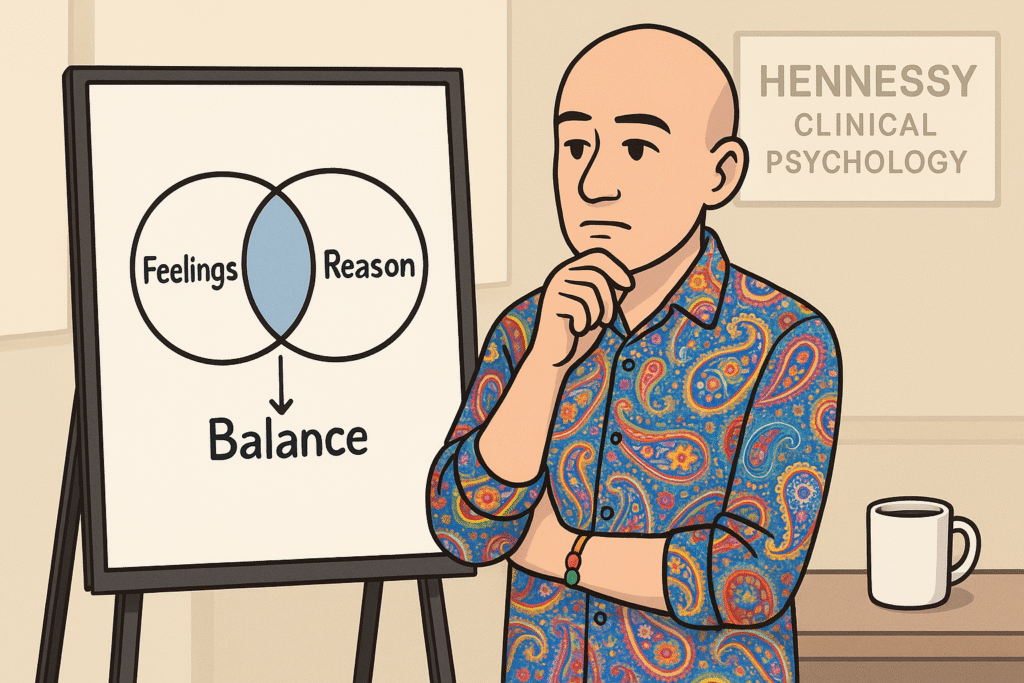
Feelings Can Override Reason: Finding Balance in Decision-Making
It is common to believe that we are primarily logical and rational in our decision-making. In reality, psychological research shows that emotions play a central role in how decisions are made. Feelings can influence attention, shape risk perception, and affect how confident we feel about our choices.
For this reason, feelings can sometimes override reason, particularly when emotional states are strong or when decisions are made quickly. Decisions are usually made through a combination of emotional signals and reflective thinking. The emotional mind may speak first, while reasoning often follows as we evaluate options more carefully.
The ongoing interaction between thoughts, emotions, and behaviour is also explored in Maintaining a Balanced Narrative Takes Ongoing Attention and Effort.
Why Feelings Shape Choices
Attention Filters
Emotions steer what we notice. Anxiety draws our focus to potential threats, while contentment can broaden our attention towards opportunity. Research on positive emotional states suggests that broadened attention can support more flexible thinking and problem solving [2].
Risk Tolerance
Positive moods can increase willingness to take risks, while negative moods often encourage more cautious choices [1].
Information Weighting
Emotions can colour how heavily we weigh certain evidence, sometimes leading us to dismiss useful facts or place too much emphasis on less relevant details.
Confidence
Mood influences how sure we feel about our judgment, regardless of the objective quality of the decision [3].
Steps Towards Balanced Decisions
While feelings cannot be removed from decision-making, and should not be, we can practise creating space for both head and heart.
Practise Delayed Gratification
Giving ourselves time and space before acting helps us step back from the immediate pull of emotion. This delay allows us to potentially view decisions through less intense emotional states and sometimes through a different perspective altogether. Waiting a few minutes, hours, or days can shift the balance towards wiser choices.
Pause and Notice the Mood
Take a brief pause to ask, “What am I feeling right now and how might that be shaping this choice?”
Label the Emotion
Simply naming a feeling has been shown to reduce its intensity and create space for clearer thinking.
Check Against Values and Goals
Ask whether the choice is aligned with your longer-term values rather than only your current mood. Clarifying personal values can help guide decisions when emotions feel strong. This is explored further in Clarifying Your Values: Enhance Your Life Direction.
Use Perspective-Taking
Imagine how you might view the same decision tomorrow, or how a trusted friend might see it.
Regulate Before Deciding
Practices such as slow breathing, mindfulness, or walking in nature can calm emotional reactivity so that rational thought has more opportunity to participate in the decision. Developing everyday self-care habits can support this process, as discussed in Mindful Self-Care: Simple Things Matter. If emotional arousal is making it difficult to slow down, some readers may also find practical support in Four Grounding Exercises to Help Soothe Anxiety.
Practise Reviewing Past Decisions With Curiosity Rather Than Judgment
Looking back at previous decisions with curiosity can help us recognise patterns in how emotions influence choices. Over time, this can strengthen self-awareness and support wiser decisions in the future.
Frequently Asked Questions
Are emotions bad for decision-making?
No. Emotions provide useful information about what matters to us. They can signal needs, priorities, and potential risks. Difficulties tend to arise when emotional reactions dominate without reflection.
Why do emotions influence our decisions so strongly?
Emotions influence attention, memory, and risk perception. Psychological research shows that mood can shape what information we notice, how we interpret situations, and how confident we feel about our choices.
Can slowing down help improve decision-making?
Yes. Allowing time between feeling and action can reduce impulsive responses. Even a brief pause can allow emotional intensity to settle and give the reflective part of the mind more opportunity to contribute to the decision.
Does naming emotions really help?
Research suggests that identifying and naming emotions can reduce emotional intensity and support clearer thinking through changes in brain activity related to emotional regulation.
How can I make decisions more calmly?
Pausing, naming emotions, and allowing time before acting can reduce emotional intensity. Practices such as mindfulness, breathing exercises, and reflecting on personal values can also support clearer thinking.
References
[1] Lerner, J. S., Li, Y., Valdesolo, P., & Kassam, K. S. (2015). Emotion and decision making. Annual Review of Psychology, 66, 799–823.
https://doi.org/10.1146/annurev-psych-010213-115043
[2] Fredrickson, B. L. (2001). The role of positive emotions in positive psychology: The broaden-and-build theory of positive emotions. American Psychologist, 56(3), 218–226.
https://doi.org/10.1037/0003-066X.56.3.218
[3] Schwarz, N. (2012). Feelings as information theory. In P. A. M. Van Lange, A. W. Kruglanski, & E. T. Higgins (Eds.), Handbook of Theories of Social Psychology (Vol. 1, pp. 289–308). Sage.
https://doi.org/10.4135/9781446249215.n15
[4] Lieberman, M. D., Eisenberger, N. I., Crockett, M. J., Tom, S. M., Pfeifer, J. H., & Way, B. M. (2007). Putting feelings into words: Affect labeling disrupts amygdala activity in response to affective stimuli. Psychological Science, 18(5), 421–428.
https://doi.org/10.1111/j.1467-9280.2007.01916.x
[5] Forgas, J. P. (2013). Don’t worry, be sad: On the cognitive, motivational, and interpersonal benefits of negative mood. Current Directions in Psychological Science, 22(3), 225–232.
https://doi.org/10.1177/0963721412474458
Enquiries and Appointments
We are a Gold Coast Clinical and General Psychologist clinic conveniently positioned in Varsity Lakes.
Therapy is available in person at Varsity Lakes or via telehealth anywhere in Australia.
The easiest way to book an appointment is online.