
It’s Not the Apple
By David Hennessy, Clinical Psychologist, Varsity Lakes, Gold Coast, QLD
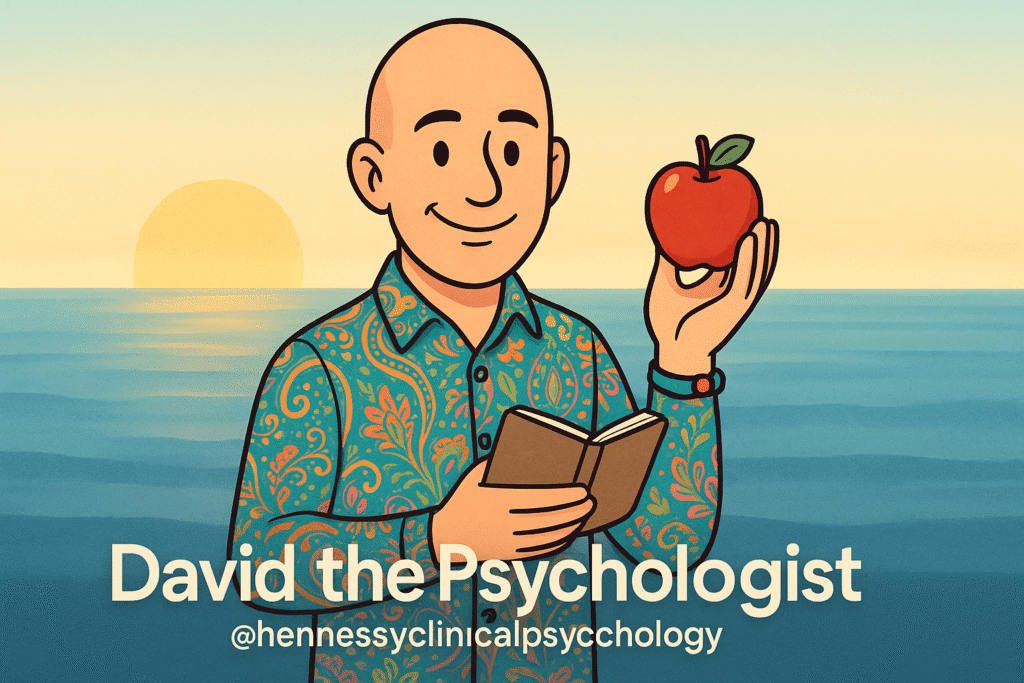
David the Psychologist reminds us: it is not the apple, but the values-based choices built into our daily routines that support lasting wellbeing.
It’s Not the Apple
We all know the old saying, “An apple a day keeps the doctor away.” Apples are a healthy choice, but the most important part here is not the apple. It is the values consistent health-related action scheduled into our daily routine that has the potential to improve our health and our lives greatly.
Small Daily Actions Matter
Health is not built in one-off gestures or single quick fixes. It grows out of the simple and steady rhythm of daily practices that align with what matters to us. Preparing nourishing food, moving our bodies, resting well, or connecting with others are small but powerful health-sustaining gestures. Just schedule the basics, do it and repeat.
This idea is explored further in our article
Mindful Self Care: Simple Things Matter,
which highlights how simple, repeated behaviours form the foundation of sustainable wellbeing rather than relying on motivation alone.
More Than Just Physical Health
The benefits are not just physical. These practices enable us to recognise our capacity to intentionally and consistently engage with, and appreciate, the simple essentials of life. They help balance our emotions, strengthen resilience, and provide a steady foundation for navigating the challenges of life.
This broader perspective is closely linked to values-based living, as discussed in
Clarifying Your Values: Enhance Your Life Direction,
where identifying what matters most helps guide consistent action even during periods of stress or uncertainty.
Lasting Wellbeing Through Consistency
So, schedule in the apple, and when doing so, remember and reflect upon that consistency of values-based choices woven into daily life supports lasting wellbeing.
For a deeper discussion of how consistency supports resilience during difficult periods, see
Surviving in Adversity,
which explores how steady, values-aligned action can help people remain grounded through challenge.
Clinical and Research Context
Values consistent action and behavioural consistency are core elements of evidence-based psychological approaches, including Acceptance and Commitment Therapy and behavioural activation. Research demonstrates that small, repeated health-related behaviours accumulate meaningful benefits over time for both physical and psychological wellbeing [1–6].
Frequently Asked Questions
Is this article about diet or nutrition advice?
No. While apples are used as a familiar metaphor, this article focuses on psychological principles related to values-based consistency and daily routines rather than specific dietary or nutrition advice.
Why does consistency matter more than motivation?
Motivation naturally fluctuates over time. Consistency is more values-based and less dependent on mood, making it a more reliable foundation for sustained behaviour change and wellbeing.
Can small daily habits really improve wellbeing?
Yes. Research shows that small, repeated behaviours accumulate over time and can meaningfully influence emotional regulation, resilience, and overall psychological wellbeing.
Is this values-based approach used in psychological therapy?
Yes. Values-consistent action and behavioural activation are well-established components of evidence-based psychological therapies, including Acceptance and Commitment Therapy.
References
- Hayes, S. C., Strosahl, K. D., & Wilson, K. G. (2016). Acceptance and commitment therapy: The process and practice of mindful change (2nd ed.). Guilford Press.
- Martell, C. R., Dimidjian, S., & Herman Dunn, R. (2010). Behavioral activation for depression: A clinician’s guide. Guilford Press.
- Lally, P., van Jaarsveld, C. H. M., Potts, H. W. W., & Wardle, J. (2010). How are habits formed: Modelling habit formation in the real world. European Journal of Social Psychology, 40(6), 998–1009.
https://doi.org/10.1002/ejsp.674 - Kalisch, R., Müller, M. B., & Tüscher, O. (2015). A conceptual framework for the neurobiological study of resilience. Behavioral and Brain Sciences, 38, e92.
https://doi.org/10.1017/S0140525X1400082X - Pressman, S. D., Jenkins, B. N., & Moskowitz, J. T. (2019). Positive affect and health: What do we know and where next should we go? Annual Review of Psychology, 70, 627–650.
https://doi.org/10.1146/annurev-psych-010418-102955 - Royal Australian College of General Practitioners. (2023). Guidelines for preventive activities in general practice (9th ed.). RACGP.
https://www.racgp.org.au/clinical-resources/clinical-guidelines/key-racgp-guidelines/view-all-racgp-guidelines/red-book
Enquiries and Appointments
We are a Gold Coast Clinical and General Psychologist clinic conveniently positioned in Varsity Lakes.
Therapy is available in person at Varsity Lakes or via telehealth anywhere in Australia.
The easiest way to book an appointment is online.