Feelings Override Reason: Finding Balance in Decision-Making
By David Hennessy, Clinical Psychologist
Feelings Override Reason: Finding Balance in Decision-Making
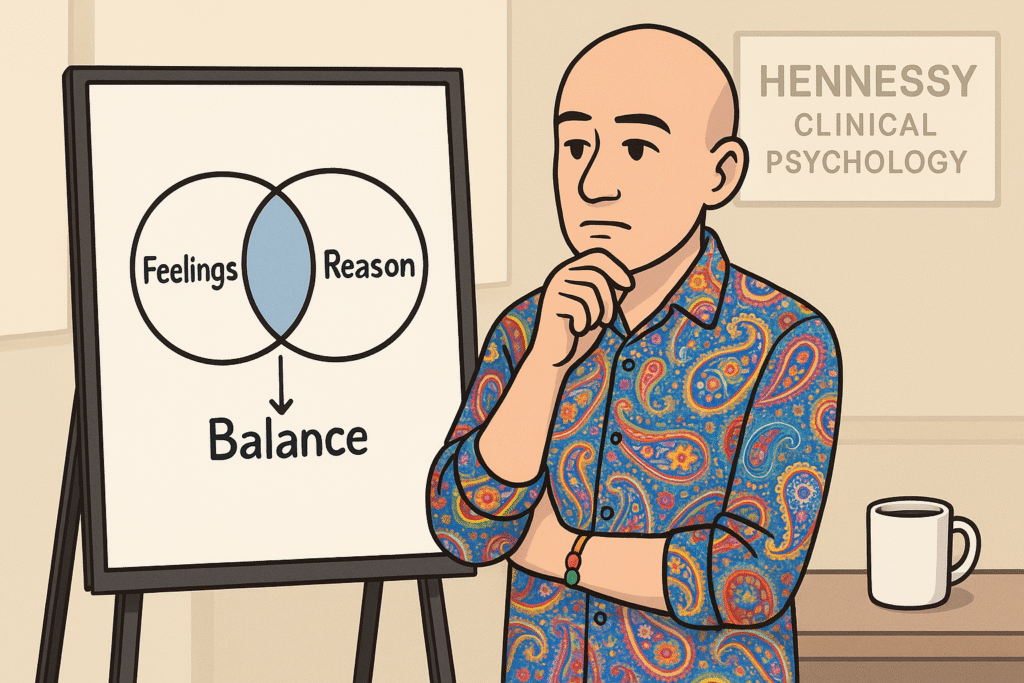
It is common to believe that we are primarily highly logical and rational in our decision-making. In truth, decisions are usually made in a mix of rational thought and emotional influence. The emotional mind often has a louder voice and sometimes it takes the wheel entirely.
Even slight variations in emotional state can influence decision-making. Research shows that our emotions shape what we pay attention to, how much risk we are willing to take, how we weigh up information, and even how confident we feel about our choices (1). This is true not just for intense states like panic or euphoria, but also for subtler shifts like mild irritation, contentment, or low-level anxiety.
Why Feelings Shape Choices
Attention filters
Emotions steer what we notice. Anxiety draws our focus to potential threats, while contentment makes us more open to opportunity.
Risk tolerance
Positive moods can increase willingness to take risks, while negative moods often encourage more cautious choices (1).
Information weighting
Emotions colour how heavily we weigh certain evidence, sometimes leading us to dismiss useful facts or overemphasise irrelevant details.
Confidence
Mood influences how sure we feel about our judgment, regardless of the actual quality of the decision (2).
Steps Towards Balanced Decisions
While feelings cannot be eliminated from decision-making and should not be, we can practise creating space for both head and heart.
Practise delayed gratification
Giving ourselves time and space before acting helps us step back from the immediate pull of an emotion. This delay allows us to potentially view our decisions through less intense and sometimes different emotions, offering a more balanced perspective. Waiting a few hours, days, or even just a few minutes can shift the balance towards wiser choices.
Pause and notice the mood
Take a brief pause to ask, “What am I feeling right now, and how might that be shaping this choice?”
Label the emotion
Simply naming a feeling has been shown to reduce its intensity and create space for clearer thought (3).
Check against values and goals
Ask whether the choice is aligned with your longer-term values, rather than just your current mood. This is explored further in our article Clarifying Your Values: Enhance Your Life Direction.
Use perspective-taking
Imagine how you might view the same decision tomorrow, or how a trusted friend would see it.
Regulate before deciding
Practices like slow breathing, mindfulness, or walking in nature can calm emotional reactivity, so rational thought can join the conversation. You may also find it helpful to read Mindful Self-Care: Simple Things Matter.
Practise reviewing past decisions with curiosity rather than judgment
This helps us notice patterns and develop greater awareness of how moods shape choices. Over time, it strengthens self-understanding and supports wiser future decisions.
Enquiries and Appointments
If you would like support in understanding emotional patterns and decision-making, you are welcome to make an enquiry or book an appointment here:
https://hennessyclinicalpsychology.com/contact/
Frequently Asked Questions
Are emotions bad for decision-making?
No. Emotions provide important information about values, needs, and potential risks. Difficulties tend to arise when emotions dominate without reflective awareness.
Why do I make decisions I later regret?
Decisions made during heightened emotional states can feel right in the moment, but less aligned with values or goals once the emotional intensity settles.
Can therapy help with emotional decision-making?
Yes. Psychological therapy can help build awareness of emotional patterns, improve regulation skills, and support more values-aligned choices over time.
Is this relevant only for mental health difficulties?
No. Emotional influence on decision-making is a universal human experience and applies to everyday choices, as well as clinical concerns.
References
1. Lerner, J. S., Li, Y., Valdesolo, P., & Kassam, K. S. (2015). Emotion and decision making. Annual Review of Psychology, 66, 799–823.
https://doi.org/10.1146/annurev-psych-010213-115043
2. Schwarz, N. (2012). Feelings as information theory. In P. A. M. Van Lange, A. W. Kruglanski, & E. T. Higgins (Eds.), Handbook of Theories of Social Psychology (Vol. 1, pp. 289–308). Sage.
https://doi.org/10.4135/9781446249215.n15
3. Lieberman, M. D., Eisenberger, N. I., Crockett, M. J., Tom, S. M., Pfeifer, J. H., & Way, B. M. (2007). Putting feelings into words: Affect labeling disrupts amygdala activity in response to affective stimuli. Psychological Science, 18(5), 421–428.
https://doi.org/10.1111/j.1467-9280.2007.01916.x