Continuing the Conversation: Grief, Memory, and Ongoing Bonds
By David Hennessy, Clinical Psychologist
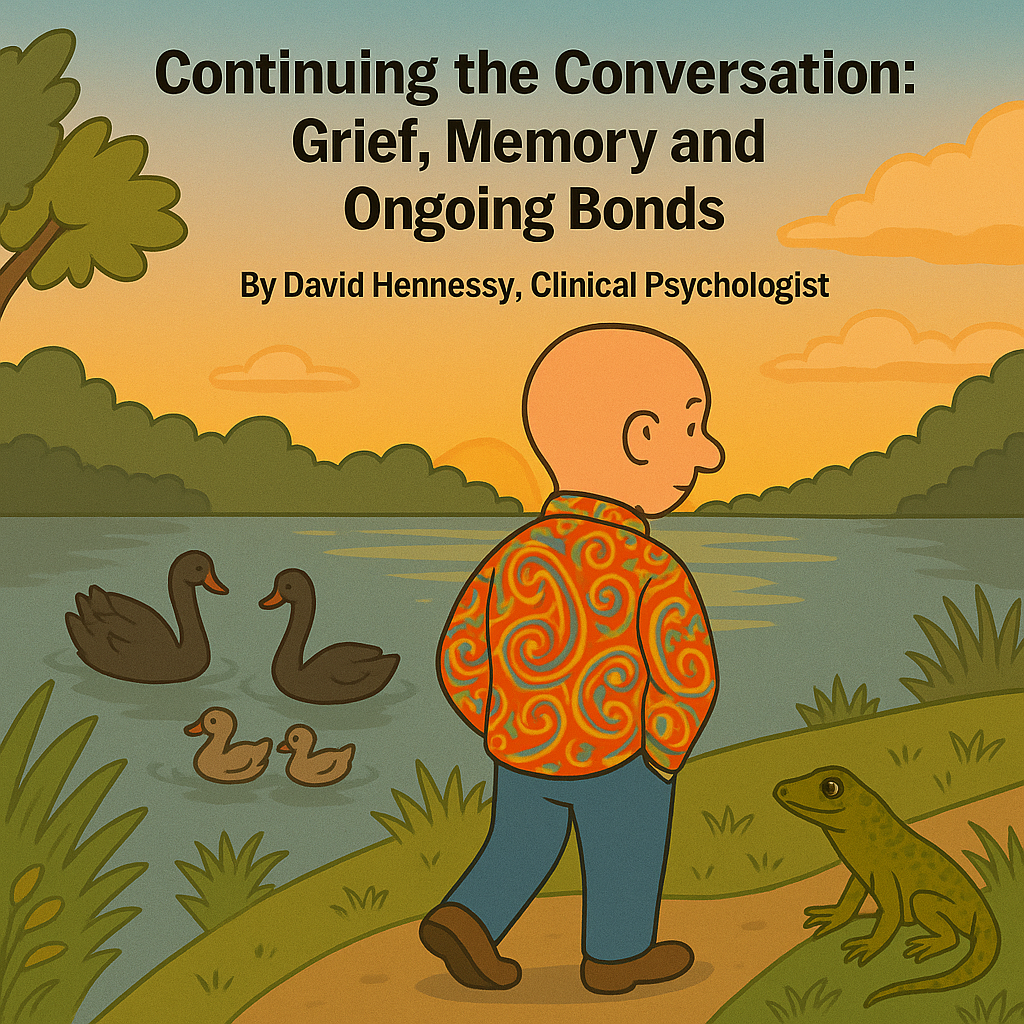
Continuing the Conversation: Grief, Memory, and Ongoing Bonds. Illustration featuring David the Psychologist.
Grieving Does Not Follow Rules
Grieving can be tough, and there is no right way to do it. All humans experience periods of distress and grief at some stage, and the way we navigate these times varies widely between people. Research indicates that grief responses are influenced by the nature of the relationship, personality, cultural values, spiritual beliefs, social support, and the circumstances surrounding the loss [1][2]. This aligns with broader observations discussed in Surviving in Adversity, Surrounded by Beauty.
Grief may be expressed openly or held quietly within. There is no single correct way to grieve. It is a deeply personal and universal human experience [3], similar to the themes explored in Understanding Ourselves.
What We Keep After They Are Physically Gone
When our loved ones are alive, it is only a small portion of our lives that is spent physically with them or directly communicating with them. Their passing means we lose the physical presence, but we continue to carry what we hold in our hearts and minds. This way of holding experience connects closely with ideas explored in Thoughts Are Just Our Minds Making Meaning.
Contemporary grief research shows that internal representations, memory, and meaning-making often play a supportive role in adjusting to loss [2][4]. These processes overlap with emotional regulation skills discussed in Managing Strong Emotions and Emotional Regulation.
Continuing the Conversation: Grief, Memory, and Ongoing Bonds
We can maintain a dialogue of communication with them. The responses, however, now come from our memories of their perspectives, values, humour, interests, biases, hopes, dreams, fears, concerns, and shared experiences. This mirrors how meaning is continually reconstructed, as explored in Gentle, Grounded Truth Might Be More Helpful Than Overly Positive Reassurance.
The ongoing bonds perspective supports the idea that sustaining an internal connection with loved ones after death can be adaptive, and emotionally meaningful [4][5]. This sits alongside broader, trauma-informed understandings described in PTSD and Complex PTSD: What Are They and How Do They Differ?.
While ever we reflect on what we hold in our hearts and minds about our loved ones, a little piece of them lives on in us.
Support and Resources
Australian Centre for Grief and Bereavement
Offers free counselling and support for individuals and families experiencing grief.
https://www.grief.org.au
Beyond Blue
Support for grief, loss, and mental health, including 24 7 support.
https://www.beyondblue.org.au | 📞 1300 22 4636
Lifeline Australia
24 7 crisis support, and suicide prevention services.
https://www.lifeline.org.au | 📞 13 11 14
Compassionate Friends Australia
Support for bereaved parents, siblings, and grandparents.
https://www.thecompassionatefriends.org.au
Hennessy Clinical Psychology
For prolonged, and or complex grief, offering compassionate, trauma-informed support in Varsity Lakes, Gold Coast.
https://hennessyclinicalpsychology.com
Enquiries / Appointments
If you would like to arrange an appointment, you can do so here:
https://hennessyclinicalpsychology.com/contact/
Frequently Asked Questions
Is it normal to keep talking to someone who has died?
For many people, yes. Continuing an inner dialogue through memory can be a natural part of grief, and it often reflects love and connection, rather than something to be feared [4][6].
What are ongoing bonds in grief?
Ongoing bonds refers to the ways people maintain a meaningful inner connection with a loved one after death, including memory, values, humour, and acts of remembrance [4][6].
Does grief follow stages?
Most people do not experience grief in neat stages. Many people move back and forth between focusing on the loss and focusing on daily life tasks [3].
When might grief become prolonged or complex?
Grief can become prolonged or more complex when distress remains intense and significantly disruptive over time. This can be more likely after traumatic circumstances, multiple losses, or when support is limited, and it may benefit from evidence-based psychological care [7].
What can help when grief comes in waves?
Grounding skills, steady breathing, and gentle reorientation to the present can help when grief surges unexpectedly. Many people also benefit from building emotional regulation skills alongside remembering and honouring the relationship [1][3].
References
- Bonanno, G. A., & Burton, C. L. (2013). Regulatory flexibility: An individual differences perspective on coping, and emotion regulation. Perspectives on Psychological Science, 8(6), 591 to 612. https://doi.org/10.1177/1745691613504116
- Field, N. P., Gao, B., & Paderna, L. (2005). Continuing bonds in bereavement: An attachment theory-based perspective. Death Studies, 29(4), 277 to 299. https://doi.org/10.1080/07481180590923689
- Stroebe, M., & Schut, H. (2010). The dual process model of coping with bereavement: A decade on. Omega: Journal of Death and Dying, 61(4), 273 to 289. https://doi.org/10.2190/OM.61.4.b
- Field, N. P., & Filanosky, C. (2010). Continuing bonds, risk factors for complicated grief, and adjustment to bereavement. Death Studies, 34(1), 1 to 29. https://doi.org/10.1080/07481180903372269
- Neimeyer, R. A. (2019). Meaning reconstruction in bereavement: Development of a research program. Death Studies, 43(2), 79 to 91. https://doi.org/10.1080/07481187.2018.1456620
- Eisma, M. C., & Nguyen, L. T. H. (2023). How we continue bonds with deceased persons: The proximity-seeking behaviour scale. Death Studies, 47(2), 1 to 11. https://doi.org/10.1080/07481187.2022.2039811
- Boelen, P. A., & Lenferink, L. I. M. (2022). Prolonged grief disorder in DSM 5 TR. Australian & New Zealand Journal of Psychiatry, 56(6), 667 to 674. https://doi.org/10.1177/00048674211025728