
By David Hennessy, Clinical Psychologist, Varsity Lakes, Gold Coast, QLD
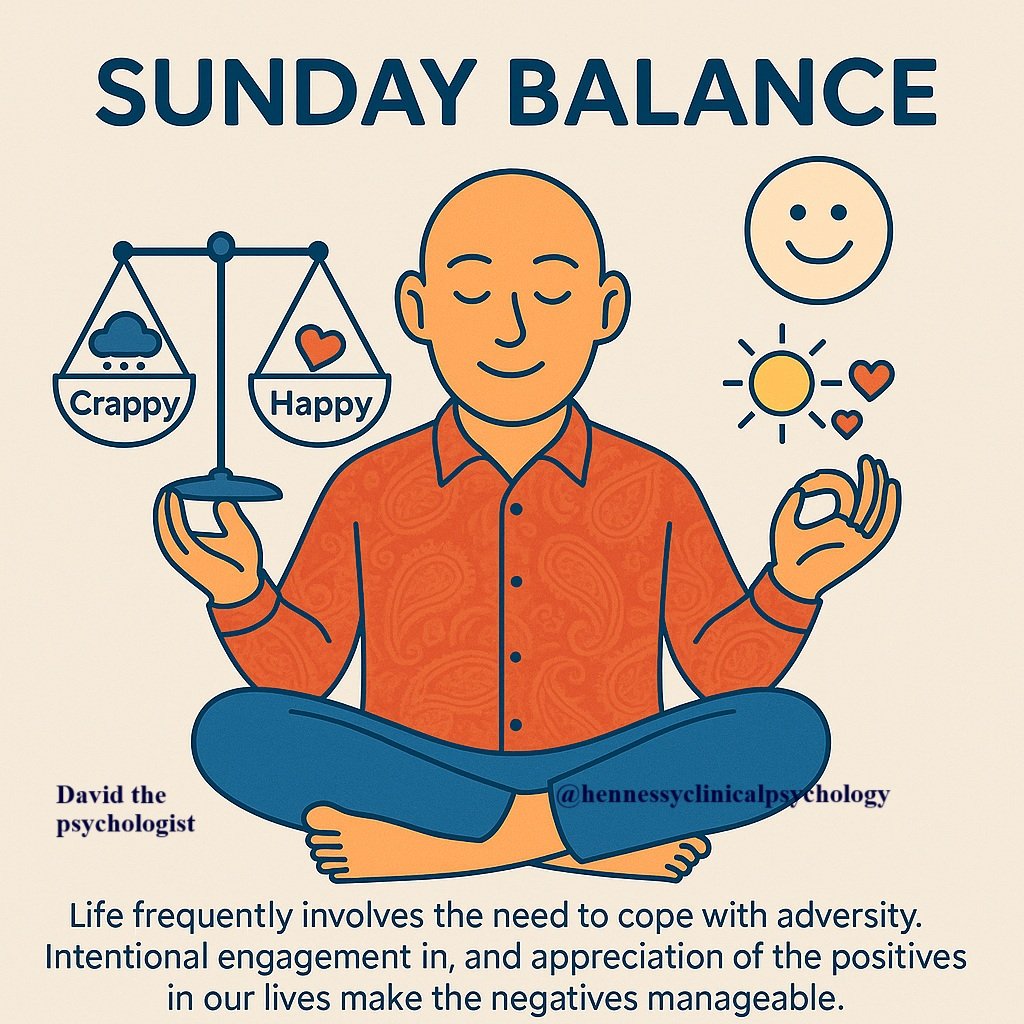
Sunday Balance | Happiness / Adversity. Life frequently involves the need to cope with adversity. Intentional engagement in, and appreciation of the positives in our lives make the negatives manageable.
This article uses Sunday as a token day. The day itself is not inherently therapeutic. In Australian culture, Sunday is commonly experienced as a day of rest, reflection, family connection, or for many people, worship. That rhythm makes it a practical anchor point for intentional pause. The principle applies equally to any day that allows space.
Many people move through the week in forward momentum. Responsibilities accumulate. Conversations overlap. Deadlines approach. Without a deliberate pause, attention narrows toward what is unfinished, uncertain, or stressful.
Psychological research demonstrates that human attention is biased toward threat. Baumeister and colleagues described this as the “bad is stronger than good” effect, showing that negative events typically exert greater psychological impact than positive ones [1]. This bias evolved for survival. In modern environments, it can narrow perspective.
Using Sunday as a pause point offers a culturally familiar opportunity to widen that lens. The goal is not forced positivity. It is balanced awareness.
You may also wish to explore Balance Happy and Crappy, which discusses how holding both positive and negative experiences supports psychological steadiness.
Providing balance to counter our natural attentional bias does not require denying hardship. It requires widening awareness.
Fredrickson’s broaden-and-build theory proposes that positive emotions broaden attention and cognition, gradually building enduring psychological resources [2]. Empirical research demonstrates that positive emotions assist individuals to recover more effectively from negative emotional experiences [3].
Resilience research describes adaptation not as exceptional strength but as ordinary processes operating effectively under stress [4]. Psychological flexibility has been consistently associated with improved mental health outcomes across populations [5].
This theme is explored further in Values, Attention and Psychological Flexibility.
More recent meta-analytic evidence indicates that structured positive psychology interventions are associated with improvements in wellbeing and reductions in depressive symptoms [6].
Ten minutes is enough. Consistency matters more than intensity.
Mindfulness-based interventions demonstrate reductions in rumination and emotional reactivity [7]. Neuroscience research suggests that repeated reflective and mindful practices may influence neural pathways associated with emotion regulation and attentional control [8]. This is steady, incremental work.
For some, Sunday holds spiritual significance. For others, it is simply the close of the week. Sunday Balance does not prescribe belief. It recognises that structured reflection, whether secular or spiritual, supports emotional regulation and perspective.
If Sunday is not meaningful in your rhythm of life, choose another pause point. The principle is transferable.
For a deeper discussion about maintaining perspective over time, see Maintaining a Balanced Narrative Takes Ongoing Attention and Effort.
You can explore more psychology articles here: Hennessy Clinical Psychology Articles.
No. Sunday is used as a culturally familiar pause point. Any consistent reflective time can serve the same purpose.
No. It means widening awareness so hardship is not the only thing in view.
Ten minutes can be sufficient when practised consistently.
[1] Baumeister, R. F., Bratslavsky, E., Finkenauer, C., & Vohs, K. D. (2001). Bad is stronger than good. Review of General Psychology, 5(4), 323–370. https://doi.org/10.1037/1089-2680.5.4.323
[2] Fredrickson, B. L. (2001). The role of positive emotions in positive psychology: The broaden-and-build theory of positive emotions. American Psychologist, 56(3), 218–226. https://doi.org/10.1037/0003-066X.56.3.218
[3] Tugade, M. M., & Fredrickson, B. L. (2004). Resilient individuals use positive emotions to bounce back from negative emotional experiences. Journal of Personality and Social Psychology, 86(2), 320–333. https://doi.org/10.1037/0022-3514.86.2.320
[4] Masten, A. S. (2001). Ordinary magic: Resilience processes in development. American Psychologist, 56(3), 227–238. https://doi.org/10.1037/0003-066X.56.3.227
[5] Kashdan, T. B., & Rottenberg, J. (2010). Psychological flexibility as a fundamental aspect of health. Clinical Psychology Review, 30(7), 865–878. https://doi.org/10.1016/j.cpr.2010.03.001
[6] Carr, A., Cullen, K., Keeney, C., et al. (2021). Effectiveness of positive psychology interventions: A systematic review and meta-analysis. Journal of Positive Psychology, 16(6), 749–769. https://doi.org/10.1080/17439760.2020.1818807
[7] Goldberg, S. B., Tucker, R. P., Greene, P. A., et al. (2018). Mindfulness-based interventions for psychiatric disorders: A meta-analysis. Clinical Psychology Review, 59, 52–60. https://doi.org/10.1016/j.cpr.2017.10.011
[8] Tang, Y.-Y., Hölzel, B. K., & Posner, M. I. (2015). The neuroscience of mindfulness meditation. Nature Reviews Neuroscience, 16(4), 213–225. https://doi.org/10.1038/nrn3916
We are a Gold Coast Clinical and General Psychologist clinic conveniently positioned in Varsity Lakes.
Therapy is available in person at Varsity Lakes or via telehealth anywhere in Australia.
The easiest way to book an appointment is online.