What Is Psychology?
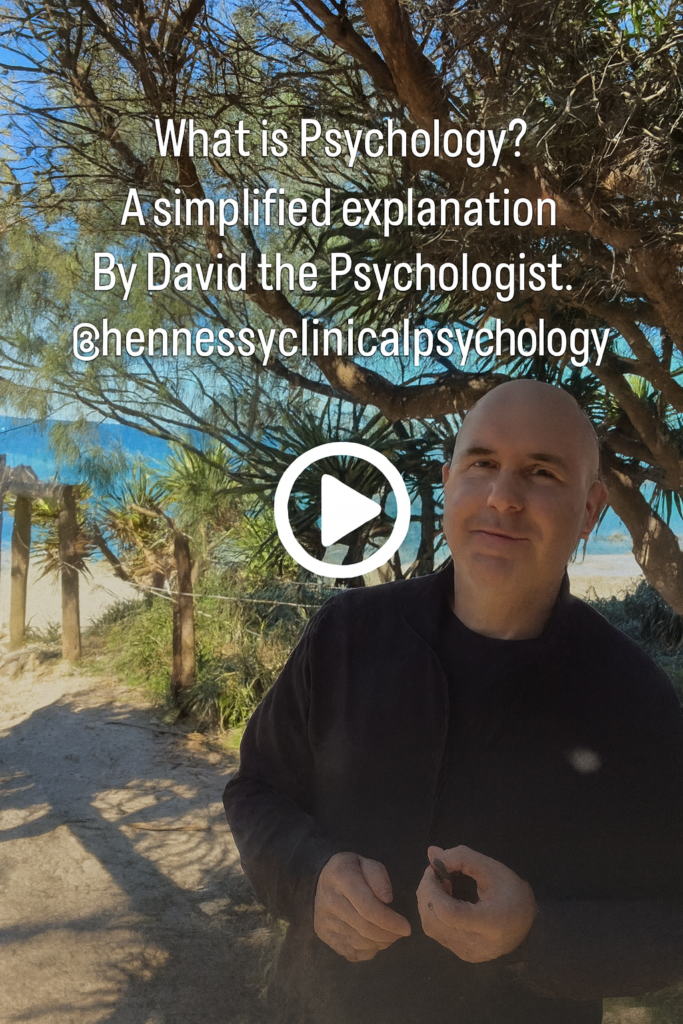
By David Hennessy, Clinical Psychologist
A highly simplified explanation? Psychology is the understanding of how the mind makes meaning and how that meaning-making drives each individual’s subjective experiences of life.
Our minds are constantly interpreting, judging, labelling, remembering, planning, imagining, regretting, and hoping. Psychology is the study of the ongoing stream of mental and neurophysiological activity and how it helps us, how it hinders us, and how we can work with it more skilfully. This includes cognitive processes, emotion regulation, attention, learning, memory, and the many ways our interpretations shape our emotional, physical, and social wellbeing [1].
Our Interpretations Shape Our Physiology
The meanings we create affect more than our emotional state. They influence how our body functions, moment by moment.
Our interpretations activate the autonomic nervous system, which regulates heart rate, breathing, digestion, muscle tension, and social engagement. This system plays a central role in our stress responses, such as fight, flight, freeze, or fawn, and in our rest and recovery states, such as rest, repair, and connect. The Polyvagal Theory describes how cues of safety or danger shift these states [2].
If our mind labels something as even mildly threatening, our body may respond with tension, racing thoughts, and physical unease. Numerous studies demonstrate that cognitive appraisal influences physiological stress reactivity, endocrine responses, and emotional experience [3].
Conversely, when a moment is interpreted as safe, predictable, and understood, the nervous system can move toward steadiness, connection, and calm. Interpersonal neurobiology highlights how this process strengthens regulation, presence, and relational capacity [4].
In short, how we interpret life changes how we live it, psychologically and physically.
Why Does It Matter?
The meanings we attach to our thoughts, memories, relationships, and our sense of self shape how we feel emotionally, how we behave, how we relate to others, how we cope with distress or uncertainty, how we function physically and socially, and how we access rest, recovery, and wellbeing.
Psychology seeks to understand these processes through research, clinical practice, and reflection. It aims to better understand human meaning-making in general and to support each individual’s journey toward insight, balance, and growth [1][5].
It Is Not Just About Mental Illness
Psychology is not only about diagnosing or treating mental health conditions. It is also about growth, meaning, performance, recovery, and connection. It helps explain why we do what we do and how we might gently shift patterns when life feels stuck or overwhelming.
Evidence-based therapies such as Acceptance and Commitment Therapy support psychological flexibility, values clarity, and the ability to take meaningful action even in the presence of difficult thoughts or emotions [5].
A Human Story
At its heart, psychology is about people. It is about how we make sense of ourselves, our relationships, our experiences, and the world around us. And it is about how those stories shape our lives, for better or worse.
The better we understand our own mind’s meaning-making, the more we can live with intention, compassion, and care. When we honour this process with curiosity rather than judgement, we support both mind and body in moving toward greater balance, calm, and connection.
Enquiries and Appointments
Click here to make an enquiry or appointment
References
- American Psychological Association. (2023). Psychology. https://doi.org/10.1037/0000033
- Porges, S. W. (2011). The polyvagal theory: Neurophysiological foundations of emotions, attachment, communication, and self-regulation. Norton.
- Jamieson, J. P., Mendes, W. B., & Nock, M. K. (2013). Improving acute stress responses. Journal of Experimental Psychology: General, 142(3), 417 to 432. https://doi.org/10.1037/a0027792
- Siegel, D. J. (2012). The developing mind: How relationships and the brain interact to shape who we are (2nd ed.). Guilford Press.
- Hayes, S. C., Strosahl, K. D., & Wilson, K. G. (2016). Acceptance and commitment therapy: The process and practice of mindful change. Guilford Press.