
Therapy for Obsessive Compulsive Disorder (OCD) in Varsity Lakes, Gold Coast, QLD
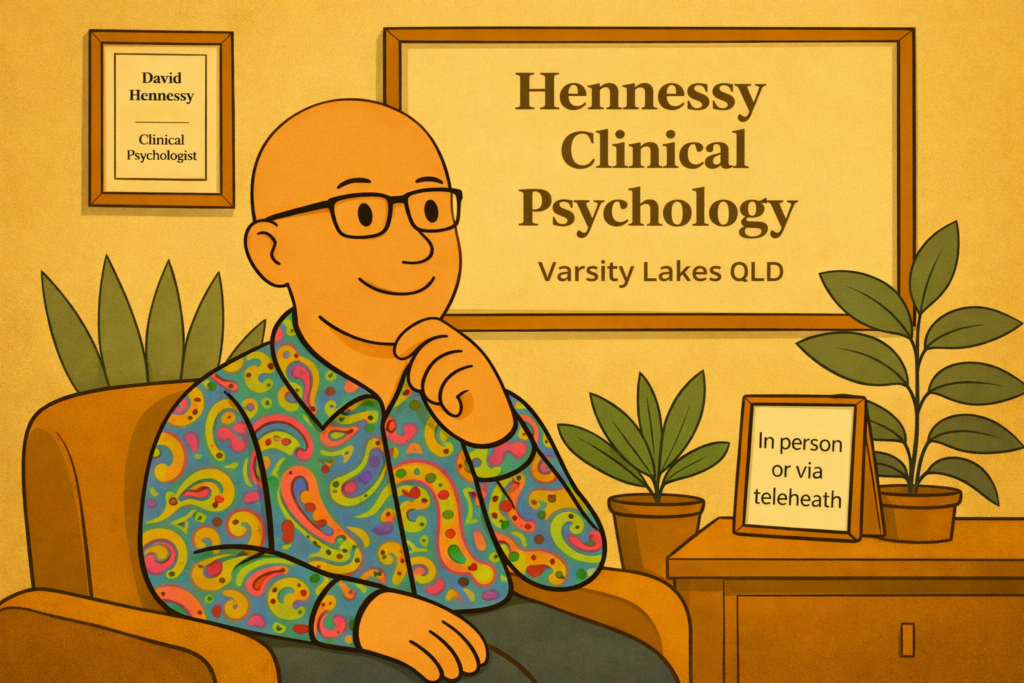
By David Hennessy, Clinical Psychologist, Varsity Lakes, Gold Coast, QLD
Understanding Obsessive–Compulsive Disorder
Obsessive–Compulsive Disorder, commonly referred to as OCD, is a chronic and often distressing mental health condition involving obsessions and compulsions.
Obsessions are intrusive, unwanted thoughts, images, or urges that trigger anxiety, guilt, disgust, or doubt. Compulsions, in contrast, are repetitive behaviours or mental rituals performed to reduce that distress.
Importantly, intrusive thoughts themselves are not abnormal. In fact, research indicates that most people experience intrusive thoughts at times. However, individuals with OCD often interpret these thoughts as dangerous or morally significant [3]. As a result, the urge to neutralise the thought can become persistent.
Large epidemiological studies estimate lifetime prevalence at approximately 2–3 percent of the population [1]. Furthermore, OCD frequently causes impairment across relationships, employment, and education [2]. Consequently, structured and evidence-based therapy can meaningfully improve functioning.
Common Presentations of OCD
Although OCD follows similar psychological mechanisms, its content varies. For example, people may experience:
- Contamination fears followed by washing rituals
- Repeated checking related to harm or mistakes
- Symmetry or ordering compulsions
- Intrusive taboo or violent thoughts
- Scrupulosity involving moral or religious doubt
Even though themes differ, the maintaining cycle remains consistent. Therefore, therapy focuses less on thought content and more on behavioural patterns that sustain anxiety.
Understanding OCD Symptoms in More Detail
While this page focuses on evidence-based therapy options available in Varsity Lakes, some readers may first want a clearer understanding of how OCD symptoms can present. If you would like a more detailed explanation of how OCD symptoms are commonly experienced and recognised, you may find this article helpful: What Does OCD Feel Like?
That page explores symptom recognition and common internal patterns, whereas the current page outlines structured, evidence-based therapy approaches for OCD in Varsity Lakes on the Gold Coast.
For additional context about nervous system regulation and meaning-making, see:
Narratives and the Nervous System: Meaningful Activity.
The OCD Anxiety Cycle
Cognitive–behavioural theory explains how OCD persists over time [3].
First, an intrusive thought appears. Next, anxiety increases. Then, a compulsion occurs. After that, anxiety decreases temporarily. Finally, the brain learns that the ritual reduced distress.
Because relief follows the compulsion, negative reinforcement strengthens the behaviour. Over time, compulsions can expand. In addition, avoidance and reassurance seeking often entrench the cycle.
Neurobiological research also identifies dysregulation in cortico–striato–thalamo–cortical circuitry, which supports behavioural and pharmacological interventions [4].
Evidence-Based Treatment for OCD
Cognitive Behaviour Therapy With Exposure and Response Prevention
Cognitive Behaviour Therapy, incorporating Exposure and Response Prevention, known as ERP, remains the first-line psychological treatment for OCD.
Multiple meta-analyses demonstrate large treatment effects across adult and adolescent populations [5,6]. Likewise, international clinical guidelines recommend ERP as a primary intervention [7].
ERP includes:
- Gradual exposure to feared triggers
- Prevention of compulsive behaviours
- Repeated learning that anxiety reduces naturally
Rather than eliminating intrusive thoughts, ERP changes the way they are responded to. Over time, new learning develops, and threat associations weaken.
Inhibitory Learning and Modern ERP
Modern ERP integrates inhibitory learning principles [8]. Instead of focusing solely on anxiety reduction, therapy strengthens corrective learning. In other words, individuals learn that feared outcomes are unlikely or manageable and, consequently, flexibility increases.
Treatment commonly ranges from 12 to 20 sessions [5], although severity and comorbidity influence duration.
For discussion about building behavioural consistency, see:
Create a Path and Practice Stick-to-itiveness.
Acceptance and Commitment Therapy as an Adjunct
Acceptance and Commitment Therapy can complement ERP. ACT enhances psychological flexibility and reduces experiential avoidance [9]. Instead of attempting to eliminate discomfort, individuals practise willingness while acting in line with values.
Combined Treatment Approaches
For moderate to severe OCD, combined CBT and selective serotonin reuptake inhibitors may produce stronger outcomes than medication alone for some individuals [10]. Treatment planning remains individualised and collaborative.
Therapy for Adolescents and Adults in Varsity Lakes
OCD often begins in childhood or adolescence, although adult onset also occurs [1]. Early intervention improves long-term outcomes [11].
In adolescents, therapy may involve family-supported ERP strategies. In adults, treatment frequently addresses occupational functioning and relationship strain.
Where complexity exists, formulation becomes essential. You may also find this page relevant:
Complex Adult Mental Health Presentations.
As someone who worked for years in the trades before retraining in psychology, I value steady, structured effort. ERP progresses incrementally. Nevertheless, consistent practice often leads to durable change.
Therapy is available in person in Varsity Lakes on the Gold Coast. Additionally, telehealth is available anywhere in Australia.
What Improvement Often Looks Like
Progress typically unfolds gradually. Initially, anxiety may rise during exposure tasks. However, with repetition, many people notice shorter spikes and improved recovery.
- Compulsions decrease
- Avoidance reduces
- Decision-making becomes clearer
- Confidence increases
Importantly, therapy does not promise certainty. Instead, it strengthens tolerance for uncertainty. Many individuals experience substantial and sustained symptom reduction following structured CBT [6].
Frequently Asked Questions
What Is the Most Effective Therapy for OCD?
Cognitive Behaviour Therapy incorporating Exposure and Response Prevention is considered first-line treatment [5,6].
How Long Does OCD Therapy Usually Take?
Many ERP programs range from 12 to 20 sessions [5]. However, duration depends on severity and complexity.
Does Exposure Therapy Mean Being Overwhelmed?
No. Exposure is gradual and collaborative. Structured hierarchies ensure manageable progression.
Can OCD Be Cured?
OCD carries a relapse risk. However, structured CBT significantly reduces symptoms for many individuals [6].
Is Medication Necessary for OCD?
Medication is not required for everyone. Nevertheless, some individuals benefit from SSRIs, particularly when combined with CBT [10].
Do Intrusive Thoughts Reflect Character?
Intrusive thoughts are common. Distress typically arises from the meaning attached to the thought rather than the thought itself [3].
Is OCD Different in Adolescents?
Core mechanisms remain similar, although therapy may involve family support. Early intervention improves prognosis [11].
References
- Ruscio, A. M., Stein, D. J., Chiu, W. T., & Kessler, R. C. (2010).
The epidemiology of obsessive–compulsive disorder in the National Comorbidity Survey Replication.
Molecular Psychiatry, 15(1), 53–63. https://doi.org/10.1038/mp.2008.94 - Markarian, Y., Larson, M. J., Aldea, M. A., Baldwin, S. A., Good, D., Berkeljon, A., Murphy, T. K., & Storch, E. A. (2010).
Impairment in obsessive–compulsive disorder: The impact of symptom severity, comorbidity, and treatment history.
Depression and Anxiety, 27(3), 292–298. https://doi.org/10.1002/da.20664 - Salkovskis, P. M. (1985).
Obsessional–compulsive problems: A cognitive–behavioural analysis.
Behaviour Research and Therapy, 23(5), 571–583. https://doi.org/10.1016/0005-7967(85)90105-6 - Pauls, D. L., Abramovitch, A., Rauch, S. L., & Geller, D. A. (2014).
Obsessive–compulsive disorder: An integrative genetic and neurobiological perspective.
Nature Reviews Neuroscience, 15(6), 410–424. https://doi.org/10.1038/nrn3746 - Olatunji, B. O., Davis, M. L., Powers, M. B., & Smits, J. A. J. (2013).
Cognitive behavioral therapy for obsessive–compulsive disorder: A meta-analysis of treatment outcome and moderators.
Psychiatric Clinics of North America, 36(3), 445–469. https://doi.org/10.1016/j.psc.2013.05.003 - McKay, D., Sookman, D., Neziroglu, F., Wilhelm, S., Stein, D. J., Kyrios, M., Matthews, K., & Veale, D. (2015).
Efficacy of cognitive–behavioral therapy for obsessive–compulsive disorder.
Journal of Anxiety Disorders, 31, 20–29. https://doi.org/10.1016/j.janxdis.2015.01.001 - National Institute for Health and Care Excellence. (2022).
Obsessive–compulsive disorder and body dysmorphic disorder: Treatment (CG31). https://www.nice.org.uk/guidance/cg31 - Craske, M. G., Treanor, M., Conway, C. C., Zbozinek, T., & Vervliet, B. (2014).
Maximizing exposure therapy: An inhibitory learning approach.
Behaviour Research and Therapy, 58, 10–23. https://doi.org/10.1016/j.brat.2014.04.006 - Bluett, E. J., Homan, K. J., Morrison, K. L., Levin, M. E., & Twohig, M. P. (2014).
Acceptance and commitment therapy for anxiety and OCD spectrum disorders: An empirical review.
Journal of Anxiety Disorders, 28(6), 612–624. https://doi.org/10.1016/j.janxdis.2014.06.008 - Simpson, H. B., Foa, E. B., Liebowitz, M. R., Huppert, J. D., Cahill, S., Maher, M. J., McLean, C. P., et al. (2013).
Adding cognitive–behavioral therapy to medication for obsessive–compulsive disorder: A randomized clinical trial.
JAMA Psychiatry, 70(11), 1190–1199. https://doi.org/10.1001/jamapsychiatry.2013.1932 - Geller, D. A., Biederman, J., Jones, J., Park, K. S., Schwartz, S., Shapiro, S., & Coffey, B. (2003).
Which SSRI? A meta-analysis of pharmacotherapy trials in pediatric obsessive–compulsive disorder.
American Journal of Psychiatry, 160(11), 1919–1928. https://doi.org/10.1176/appi.ajp.160.11.1919
Enquiries and Appointments
We are a Gold Coast Clinical and General Psychologist clinic conveniently positioned in Varsity Lakes.
Therapy is available in person at Varsity Lakes or via telehealth anywhere in Australia.
The easiest way to book an appointment is online.


