
Four Grounding Exercises to Help Soothe Anxiety
What Are Grounding Exercises?
Grounding exercises are simple techniques that help bring attention back to the present moment. When anxiety rises, the mind can move quickly toward worries, predictions, or mental replay. At the same time, the body may become tense, and breathing may become shallow.
Grounding exercises gently redirect attention toward breathing, physical sensations, or the immediate environment. This can help the nervous system gradually settle and may reduce the intensity of anxious thoughts and bodily tension.
Many psychological therapies include grounding skills as part of learning how to regulate emotions and respond to stress in a more balanced way.
When Might Grounding Exercises Help?
People often use grounding exercises when anxiety begins to build, when thoughts are racing, before sleep or when wanting to sleep, or during moments of overwhelm. Practising these skills when you are relatively calm can make them easier to use when stress is higher.
Exercise #1
Box Breathing: A Grounding Exercise for Anxiety
This can be done in four-second blocks, or sometimes three-second blocks feel more comfortable.
Breathe in for four seconds 1-2-3-4
Hold for four seconds 1-2-3-4
Breathe out for four seconds 1-2-3-4
Hold for four seconds 1-2-3-4
Tip: If four seconds feels too much, try three or even two seconds initially. Steady breathing matters more than perfect timing.
Exercise #2
Senses Exercise 5-4-3-2-1 (Repeat Several Times)
Speak quietly or silently while naming:
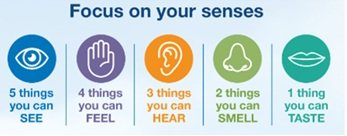
Name 5 things you can see
Name 4 things you can feel
Name 3 things you can hear
Name 2 things you can smell
Name 1 thing you can taste
Exercise #3
Mindfulness of Breath Exercise Deep, Calm, Cool, Warm (Repeat Several Times)
Say quietly or silently:
Say “Deep” on the in breath (Gently breathe down into your tummy. Notice your tummy rise.)
Say “Calm” on the out breath (Wriggle your fingers and toes as you gently breathe out.)
Say “Cool” on the in breath (Notice the feeling of cool on your face as air enters.)
Say “Warm” on the out breath (Notice the feeling of warmth on your face as you gently breathe out.)
Each time you notice your attention has drifted away from Deep, Calm, Cool, Warm, gently bring it back to Deep, Calm, Cool, Warm.
It is very common for attention to wander during this exercise. Each time you gently return your attention to the breathing words, you are strengthening the skill of mindful attention.
Exercise #4
Progressive Muscle Relaxation (Repeat Several Times)
This exercise helps the body learn the difference between tension and relaxation. Many people are surprised to notice how much tension the body carries without realising it. Progressive muscle relaxation works by gently tensing and then releasing different muscle groups so the body can learn what relaxation actually feels like.
Step 1 – Get Comfortable
Sit comfortably or lie down. Allow your arms to rest loosely by your sides. Unclench your jaw if needed. Take two slow, gentle breaths.
Step 2 – Begin with the Feet
Gently tense the muscles in your feet by curling your toes slightly. Hold the tension for about five seconds. Then slowly release the tension and notice the feeling of relaxation for a few moments before moving on.
Step 3 – Move Slowly Up the Body
Continue the same process with each muscle group. Gently tense, briefly hold, then slowly release.
Calves – tighten slightly, hold briefly, then relax.
Thighs – gently squeeze the muscles, hold briefly, then relax.
Stomach – tighten slightly, hold briefly, then release.
Hands – gently make fists, hold briefly, then open the hands.
Arms – bend the arms slightly and tighten the muscles, then relax.
Shoulders – lift the shoulders gently toward the ears, hold briefly, then let them drop.
Face – gently tighten the facial muscles, hold briefly, then relax.
Step 4 – Notice the Difference
Take two or three slow breaths and notice how your body feels compared with when you began. You may notice warmth, heaviness, softness, or simply a slight reduction in tension.
References
Bernstein, D. A., & Borkovec, T. D. (1973). Progressive relaxation training: A manual for the helping professions. Champaign, IL: Research Press.
Clark, D. A., & Beck, A. T. (2011). Cognitive therapy of anxiety disorders: Science and practice. New York: Guilford Press.
Conrad, A., & Roth, W. T. (2007). Muscle relaxation therapy for anxiety disorders: It works but how? Journal of Anxiety Disorders, 21(3), 243–264.
DOI: https://doi.org/10.1016/j.janxdis.2006.08.001
Hofmann, S. G., & Gómez, A. F. (2017). Mindfulness-based interventions for anxiety and depression. Psychiatric Clinics of North America, 40(4), 739–749.
DOI: https://doi.org/10.1016/j.psc.2017.08.008
Jerath, R., Edry, J. W., Barnes, V. A., & Jerath, V. (2006). Physiology of long pranayamic breathing: Neural respiratory elements may provide a mechanism that explains how slow deep breathing shifts the autonomic nervous system. Medical Hypotheses, 67(3), 566–571.
DOI: https://doi.org/10.1016/j.mehy.2006.02.042
Kabat-Zinn, J. (2013). Full catastrophe living: Using the wisdom of your body and mind to face stress, pain, and illness. Revised edition. New York: Bantam Books.
Khoury, B., Sharma, M., Rush, S. E., & Fournier, C. (2015). Mindfulness-based stress reduction for healthy individuals: A meta-analysis. Journal of Psychosomatic Research, 78(6), 519–528.
DOI: https://doi.org/10.1016/j.jpsychores.2015.03.009
Öst, L.-G. (1987). Applied relaxation: Description of a coping technique and review of controlled studies. Behaviour Research and Therapy, 25(5), 397–409.
DOI: https://doi.org/10.1016/0005-7967(87)90017-9
Varvogli, L., & Darviri, C. (2011). Stress management techniques: Evidence-based procedures that reduce stress and promote health. Health Science Journal, 5(2), 74–89.
Further Reading
If you would like to explore related topics in more depth, you may find the following articles helpful:
- What Does Generalised Anxiety Disorder Feel Like?
- Therapy for Generalised Anxiety Disorder in Varsity Lakes
- What Does Social Anxiety Feel Like?
- Therapy for Social Anxiety
- Mindfulness and Self-Compassion Practices for Wellbeing
- Maintaining a Balanced Internal Narrative
Frequently Asked Questions
How often should I practise these exercises?
Many people practise these exercises once or twice a day when they are relatively calm. Regular practice can make the skills easier to access during stressful moments.
Which exercise works best for anxiety?
Different exercises work better for different people. Some respond well to breathing exercises, while others prefer grounding through the senses or muscle relaxation.
Can these exercises stop a panic attack?
These exercises may reduce the intensity of anxiety by helping the nervous system regulate. They are not about forcing panic to stop, but rather allowing the body to settle.
Why does my mind keep wandering during mindfulness exercises?
This is completely normal. Each time you notice the mind wandering and gently bring it back, you are strengthening the skill of mindful attention.
Are these exercises used in therapy?
Yes. Breathing exercises, grounding techniques, mindfulness practices, and progressive muscle relaxation are commonly used within evidence-based psychological therapies.
When should I consider speaking with a psychologist?
If anxiety, panic, or ongoing stress is interfering with sleep, work, relationships, or daily functioning, it may be helpful to speak with a qualified psychologist. Professional support can provide a more personalised understanding of what may be contributing to the difficulty and what may help.
Enquiries and Appointments
We are a Gold Coast Clinical and General Psychologist clinic conveniently positioned in Varsity Lakes.
Therapy is available in person at Varsity Lakes or via telehealth anywhere in Australia.
The easiest way to book an appointment is online.


