
Context and popular culture Sway perception
By David Hennessy, Clinical Psychologist
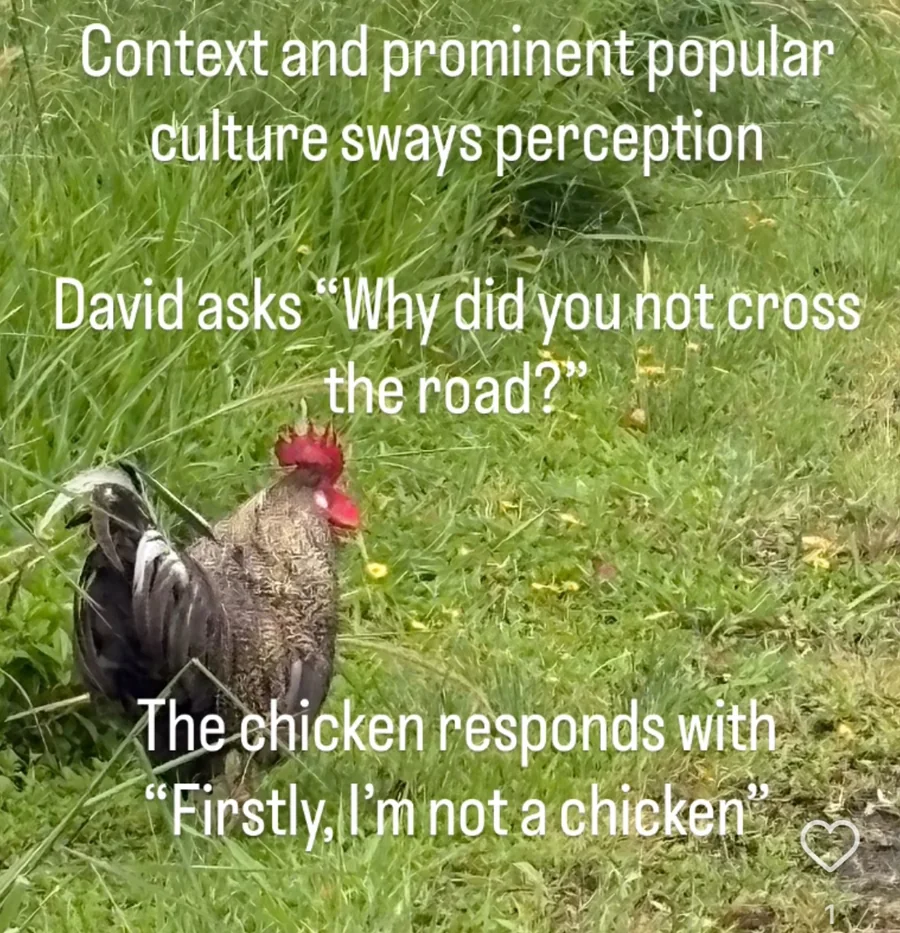
Context And Prominent Popular Culture Sway Perception
As human beings, we are all walking through the same world, yet none of us truly shares the same moment in the same way. Our perception is shaped by our history, our physiology, our personal beliefs, our cultural experiences, and even the stories circulating around us. Importantly, one of the key things that motivated me to pursue that deeply challenging change from being a marine mechanic to becoming a counsellor and eventually a clinical psychologist was my fascination with how we are all looking at the same world, but each of us is seeing each moment differently depending on individual factors.
How We Believe We See The World
At first glance, we often think of ourselves as rational beings observing reality as it is. However, decades of psychological science show that perception is not a passive process. Instead, it is an interpretive act. Each of us constructs a personal narrative that helps us organise experience and navigate the world. In practice, our minds weave together memory, emotion, expectation, culture and personal history to create a sense of meaning. While people often share broad similarities, no two individuals ever experience a moment in exactly the same way.
How Context Shapes What We See
More broadly, context is far more than the situation we are in. It includes our physical state, such as fatigue, hunger or pain, our emotional tone at the time, our personal and cultural history, the brain’s predictions and expectations, current stress levels, and the cultural messages and media influences we absorb. As a result, two people can walk into the same room and feel entirely different things. One may feel calm and open, while another may feel tense or overwhelmed. When viewed through this lens, behaviour makes sense because perception is always shaped by the context of the perceiver.
Popular Culture And The Stories That Influence Us
At a societal level, popular culture plays a powerful role in shaping perception. Films, television, social media and public narratives influence how we understand identity, coping, relationships, success and emotional expression. Some messages are helpful, while others are unrealistic. Many operate quietly in the background. Consequently, when we measure ourselves against cultural stories rather than our own values, distress and confusion can arise. A gentle and more workable approach involves noticing these influences with curiosity and choosing responses guided by meaning rather than pressure.
Why This Matters For Psychological Health
From a psychological perspective, the brain is not a recorder. Rather, it functions as a prediction engine. It interprets experience based on memory, expectations, beliefs and sensory input. Over time, these processes shape perception, emotion and behaviour in every moment. In therapy, understanding these processes helps people respond with more compassion toward themselves, reduce self-criticism, see behaviour in context, clarify values and intentions, increase psychological flexibility, and feel more grounded and less overwhelmed.
Moving Forward With Awareness And Compassion
Ultimately, we all interpret the world through filters shaped by context, history and culture. This is not a flaw. It is part of being human. With this in mind, awareness creates choice, and choice supports change. When we approach ourselves and others with curiosity rather than judgement, we open space for insight, connection and growth. If your perception is creating distress or confusion, therapy offers a supportive place to explore your meaning-making with compassion and clarity.
Related Articles
- What Is Psychology?
- Clarifying Your Values: Enhance Your Life Direction
- Managing Strong Emotions
- Attachment Wounds Explained
- What Is Trauma-Informed Therapy?
References
- Bruner, J. (1991). The narrative construction of reality. Critical Inquiry, 18(1), 1–21.
- Neisser, U. (1967). Cognitive psychology. Appleton Century Crofts.
- Bartlett, F. C. (1932). Remembering: A study in experimental and social psychology. Cambridge University Press.
- Goffman, E. (1974). Frame analysis: An essay on the organisation of experience. Harper and Row.
- Sprevak, M., & Smith, R. (2023). An introduction to predictive processing models of perception and decision making. Topics in Cognitive Science. https://doi.org/10.1111/tops.12704
- de Lange, F. P., Heilbron, M., & Kok, P. (2018). How do expectations shape perception? Trends in Cognitive Sciences, 22(9), 764–779. https://doi.org/10.1016/j.tics.2018.06.002
- Walsh, K. S., McGovern, D. P., Clark, A., & O’Connell, R. G. (2020). Evaluating the neurophysiological evidence for predictive processing. Frontiers in Psychology. https://pmc.ncbi.nlm.nih.gov/articles/PMC7187369/
- Pezzulo, G., et al. (2019). Symptom perception from a predictive processing perspective. Clinical Psychology & Psychotherapy. https://pmc.ncbi.nlm.nih.gov/articles/PMC7081568/
Frequently Asked Questions
Why do people perceive the same situation differently?
People perceive situations differently because perception is shaped by personal history, emotional state, expectations, cultural background, and current stress levels. Rather than recording objective reality, the brain actively interprets experience.
How does popular culture influence perception?
Popular culture influences perception by shaping expectations about identity, coping, relationships, success, and emotional expression. These influences often operate subtly and can affect how people interpret their own experiences.
Is perception always accurate?
Perception is usually meaningful rather than objectively accurate. It reflects how the mind makes sense of experience based on context and past learning, which can reduce self-criticism when better understood.
How does therapy help with perception and meaning-making?
Therapy helps people explore how their perceptions have developed, understand the contexts that shape them, and gradually create more flexible and value-aligned ways of responding to experience.
When should someone seek professional support?
If perception is creating distress, confusion, or difficulty in relationships or daily functioning, professional psychological support can help provide clarity, grounding, and emotional regulation.
Enquiries / Appointments
You can enquire or book an appointment at https://hennessyclinicalpsychology.com/contact/