
Psychology and Acquired Brain Injury
By David Hennessy, Clinical Psychologist
Introduction
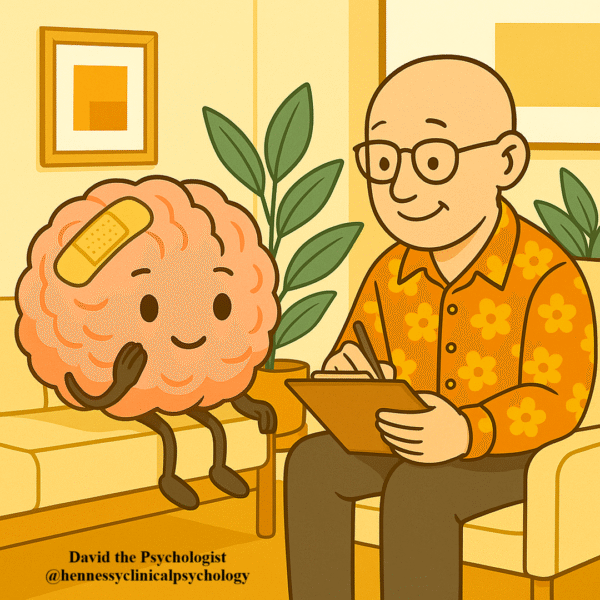
ABI and Psychology. An Acquired Brain Injury (ABI) can profoundly alter a person’s life, affecting memory, personality, emotions, and relationships. While medical teams often lead the initial treatment, psychological support is essential in adjusting to life after a brain injury. Whether caused by trauma, stroke, tumour, hypoxia, or infection, ABI impacts not only the individual but also their loved ones and community.
As clinical psychologists, our role is to walk alongside people as they process these changes, rebuild identity, and develop strategies for living meaningfully.
What Is an Acquired Brain Injury
ABI refers to any brain damage that occurs after birth and is not related to a congenital or degenerative condition. Causes include:
- Traumatic brain injury, such as car accidents, falls, or assaults
- Stroke
- Brain tumours
- Oxygen deprivation, such as near-drowning or cardiac arrest
- Infections such as meningitis or encephalitis
- Toxic exposure, such as substance use or chemical poisoning
Every brain injury is unique. Some individuals may experience only subtle cognitive shifts, while others face significant changes in speech, movement, behaviour, or personality.
Psychological Impact of ABI
People living with ABI often describe a before-and-after sense of self. Common emotional and psychological consequences include:
- Grief and loss. Loss of skills, relationships, or independence can bring profound sadness and frustration
- Depression and anxiety. As individuals become aware of their limitations, mental health symptoms may increase [2][5]
- Irritability, agitation, or emotional dysregulation. These can result from neurological damage and psychological strain [4][5]
- Social isolation. Cognitive or behavioural changes can interfere with friendships and work roles [6][5]
- Identity confusion. Many feel they are no longer the person they once were
Carers and family often experience their own emotional challenges — grief for the changed person, loss of shared roles, anxiety about the future, and stress from increased care responsibilities. Psychological support needs to include carers and family to help manage these changes together.
ABI and Psychology | How Psychology Can Help
A skilled psychologist can offer strategies, compassion, structure, and hope. Support may include:
- Adjustment counselling to help process grief, identity shifts, and new limitations
- Cognitive rehabilitation strategies to improve attention, memory, or problem solving [3][1][6]
- Support for carers and family navigating their emotional responses and changing roles — for example, facilitating family counselling, psychoeducation, and shared goal setting
- Mindfulness and self-regulation training to reduce frustration and improve mood [6][5]
- Vocational or goal-setting support for returning to valued roles or discovering new ones
Rebuilding Life With Dignity
While ABI recovery is often nonlinear, psychological healing is always possible. Sometimes it is about adapting goals, rediscovering meaning, or finding new strengths and roles. At times, it may mean grieving who we once were while learning to live richly as the person we are now.
Supportive psychological care can help survivors and families adjust, restore functioning where possible, and cultivate a renewed sense of hope, meaning and dignity.
References
- Bayley, M. T., Tate, R., Ponsford, J., & INCOG Group. (2014). INCOG guidelines for cognitive rehabilitation following traumatic brain injury: Methods and overview. Journal of Head Trauma Rehabilitation, 29(4), 290–306. https://doi.org/10.1097/HTR.0000000000000070
- Ponsford, J., Draper, K., & Schönberger, M. (2008). Functional outcome ten years after traumatic brain injury: Its relationship with demographic, injury severity, and cognitive and emotional status. Journal of the International Neuropsychological Society, 14(2), 233–242. https://doi.org/10.1017/S1355617708080272
- Julien, A., Danet, L., & Loisel, M. (2023). Update on the efficacy of cognitive rehabilitation after moderate to severe traumatic brain injury: A scoping review. Archives of Physical Medicine and Rehabilitation, 104(2), 315–330. https://doi.org/10.1016/j.apmr.2022.07.007
- Torregrossa, W., et al. (2023). Behavioural and psychiatric symptoms in patients with traumatic brain injury: A systematic overview. Biomedicines, 11(5), 1449. https://doi.org/10.3390/biomedicines11051449
- Min, J. H., & Yoon, S. J. (2022). Treatment and rehabilitation for traumatic brain injury: Current trends. Frontiers in Neurology. https://doi.org/10.3389/fneur.2022.983347
- Ramos-Galarza, C., et al. (2025). Neuropsychological rehabilitation for traumatic brain injury: Systematic review of methods and efficacy (2019–2024). Journal of Clinical Medicine. https://doi.org/10.3390/jcm14041287