The Power Of Doing Nothing
By David Hennessy, Clinical Psychologist, Varsity Lakes, Gold Coast, QLD
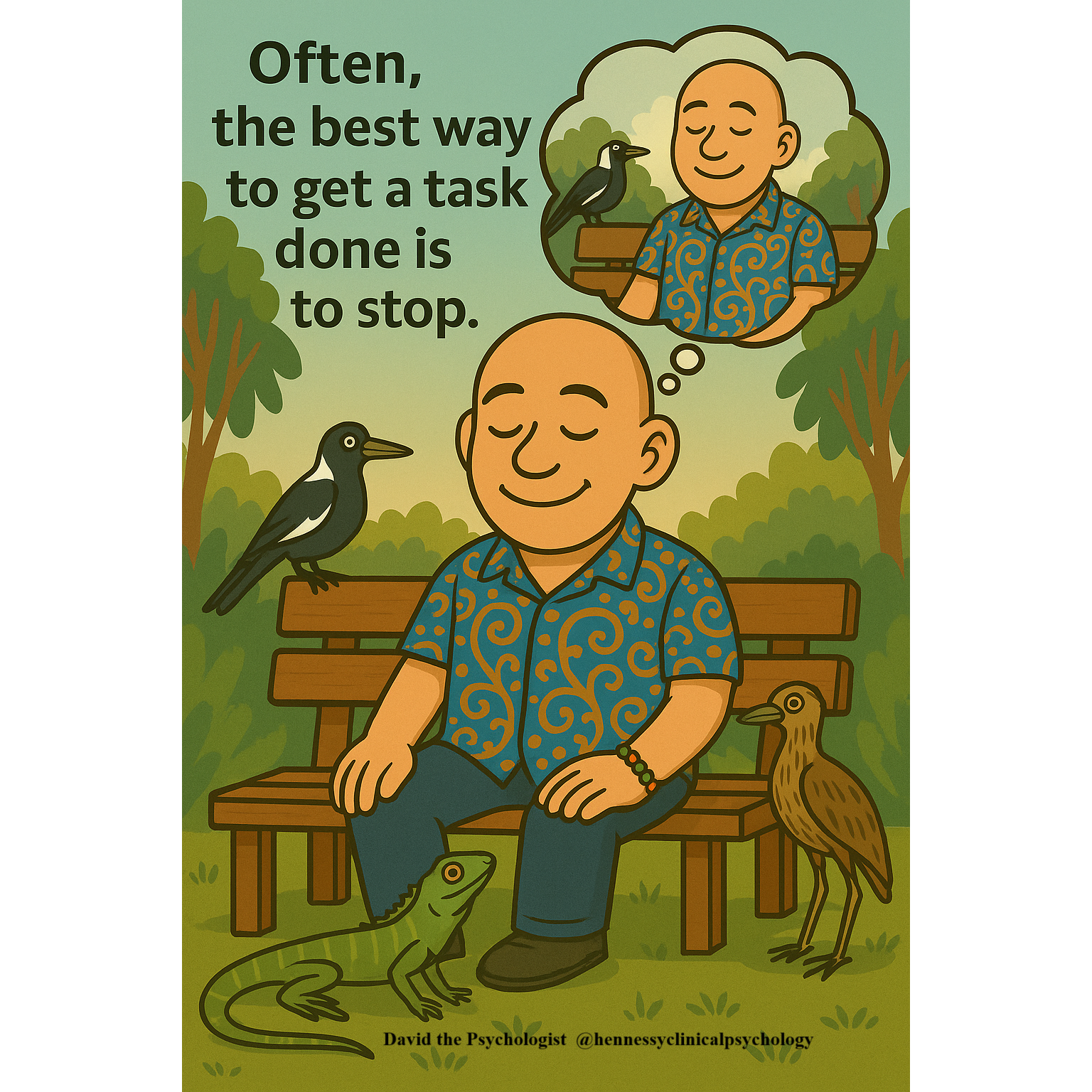
Often, the best way to move forward is to stop. At times, the most productive thing we can do is nothing. Not permanently, but temporarily. In other words, to pause. To breathe. To allow space for recalibration.
The Power Of Doing Nothing
Rest, pause and reflection are not rewards we earn by completing a to do list. Rather, they are part of balanced and sustainable human functioning. Research across cognitive psychology and neuroscience shows that intentional rest supports clearer thinking, steadier emotional regulation and improved nervous system recovery [1, 2]. In addition, sustained stress has been shown to disrupt prefrontal networks involved in executive functioning, whereas recovery periods protect cognitive flexibility and working memory [3].
Moreover, pausing can help lift mental fog, reduce feelings of overwhelm and restore motivation by allowing the brain to shift into internally oriented processing modes, including activity within the default mode network, which is associated with reflection and integration of experience [4]. At the same time, research on psychological detachment and recovery demonstrates that stepping back from ongoing demands supports long term functioning and reduces burnout risk [5]. As a result, when we step back, even briefly, we often return with greater clarity, perspective and capacity.
This principle aligns with themes explored further in Narratives and Nervous System and Values, Attention and Psychological Flexibility, where attentional restoration and nervous system regulation are discussed in greater depth.
Therefore, if you are feeling fatigued, it may not be that you need to try harder. Instead, you may need to stop. Just for a while.
The Power Of Doing Nothing
Practice striking a balance between persistence and pause. Intentionally doing nothing between the busyness is not laziness. Rather, it is deliberate recovery time that allows the organism that is us to relax and reset. In this way, doing nothing becomes restorative. It creates space to feel, to reflect and to simply be.
In that space, healing happens.
Insight arises.
And energy returns.
Frequently Asked Questions
Is Doing Nothing The Same As Being Unproductive?
No. Evidence suggests that deliberate rest improves attention and cognitive control rather than undermining productivity [2, 3]. Consequently, brief pauses often enhance performance over time.
What Happens In The Brain When We Pause?
During rest, the brain frequently shifts into activity within the default mode network, which is associated with reflection, autobiographical processing and integration of experience [4]. This state can support perspective and meaning-making.
Is Rest Helpful For Burnout?
Research on psychological detachment indicates that stepping away from work-related demands plays an important role in recovery and sustainable functioning [5]. Without recovery, stress accumulates and cognitive efficiency declines.
References
- Kaplan, S. (1995). The restorative benefits of nature: Toward an integrative framework. Journal of Environmental Psychology, 15(3), 169–182. https://doi.org/10.1016/0272-4944(95)90001-2
- Berman, M. G., Jonides, J., & Kaplan, S. (2008). The cognitive benefits of interacting with nature. Psychological Science, 19(12), 1207–1212. https://doi.org/10.1111/j.1467-9280.2008.02225.x
- Arnsten, A. F. T. (2009). Stress signalling pathways that impair prefrontal cortex structure and function. Nature Reviews Neuroscience, 10(6), 410–422. https://doi.org/10.1038/nrn2648
- Raichle, M. E. (2015). The brain’s default mode network. Annual Review of Neuroscience, 38, 433–447. https://doi.org/10.1146/annurev-neuro-071013-014030
- Sonnentag, S., & Fritz, C. (2015). Recovery from job stress: The stressor detachment model. Journal of Organizational Behavior, 36(S1), S72–S103. https://doi.org/10.1002/job.1924
Enquiries And Appointments
We are a Gold Coast Clinical and General Psychologist clinic conveniently positioned in Varsity Lakes.
Therapy is available in person at Varsity Lakes or via telehealth anywhere in Australia.
The easiest way to book an appointment is online.